
California's SPARE Act: What to Know Before You Hire a Process Server
If you file civil cases in California, the rules for proving service are changing. On January 1, 2027, most of the Service of Process Accountability, Reform and Equity Act, known as the SPARE Act or AB 747, takes effect. Governor Newsom signed it on October 10, 2025.
The law is aimed at "inadequate and even fraudulent service." It asks process servers to back up their proofs of service with photos, timestamps and location data. If a defendant later says they were never served, the party that hired the server now has to prove that service was lawful.
That means the process server you hire, and the tools they use, matter more than they used to.
Ready to order? You can place your order with the ordering assistant on this page. Every agency it offers runs its jobs on software built for these rules.
What the SPARE Act requires
Here is a high-level summary. Your attorney or the bill text is the final word on how it applies to your case.
A photo of every attempt
For personal delivery, substituted service and posting, the proof of service must include a photo of the place where each attempt was made. At a home, that's the door or entrance. At a business, it's the entrance to the specific office.
A date, time and GPS stamp on each photo
Each photo needs a readable stamp showing the date, time and GPS (or equivalent) coordinates of the attempt. If the server can't safely take a photo, or there's no GPS or cell signal, they have to give a written explanation instead.
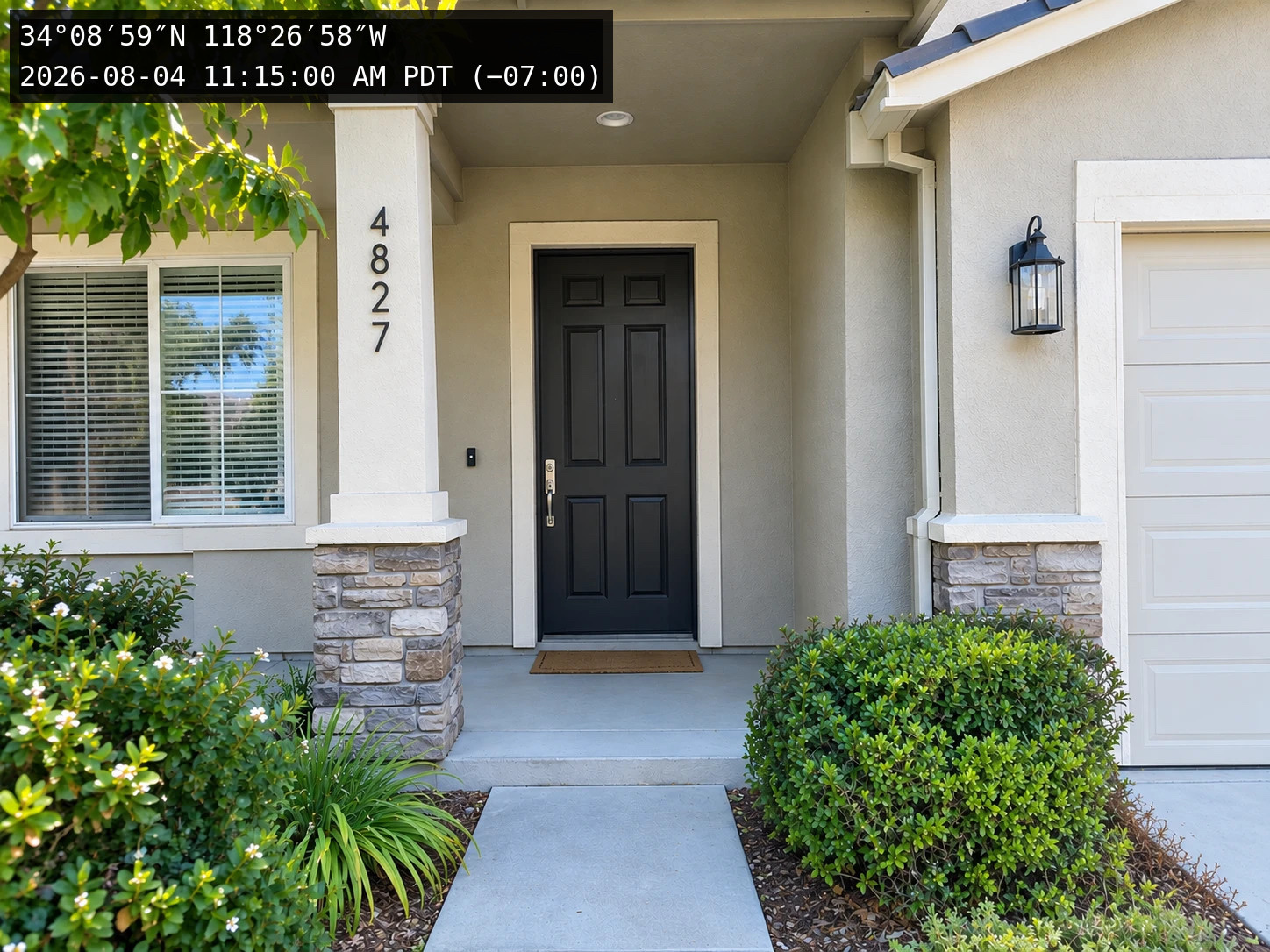
Three attempts before substituted service or posting
Before a server can leave papers with someone else or post them, they must make good-faith attempts at personal delivery on three different days at three different times. In consumer debt cases, and in most unlawful detainer (eviction) cases, at least one of those attempts must be at the person's home if it's known or can be found.
The server's registration number on the proof
A proof of service signed by a registered California process server must show the registration number assigned by the county clerk. County clerks must also keep a public register of process servers, so you can check who you're hiring.
More ways to challenge a default
Under the new CCP § 473.2, a defendant who says they weren't properly served can move to set aside a default or default judgment. Once they offer evidence of improper service, the party that got the default has to prove that service was lawful. A judgment that's void for lack of proper service can be challenged at any time.
The Judicial Council has also proposed updated proof of service forms to match the new rules.
What this means if you're ordering service
If your proof of service is thin, your default judgment is at risk. A notarized declaration on its own won't carry the weight it used to. You'll want photos, timestamps and GPS data for every attempt, attached to the proof and easy to produce if the service is ever questioned.
Most of that work falls on the process server. But it only gets done consistently if the server uses software that captures it at the moment of each attempt. Notes written up afterward, or photos pulled from a personal phone, are much harder to stand behind.
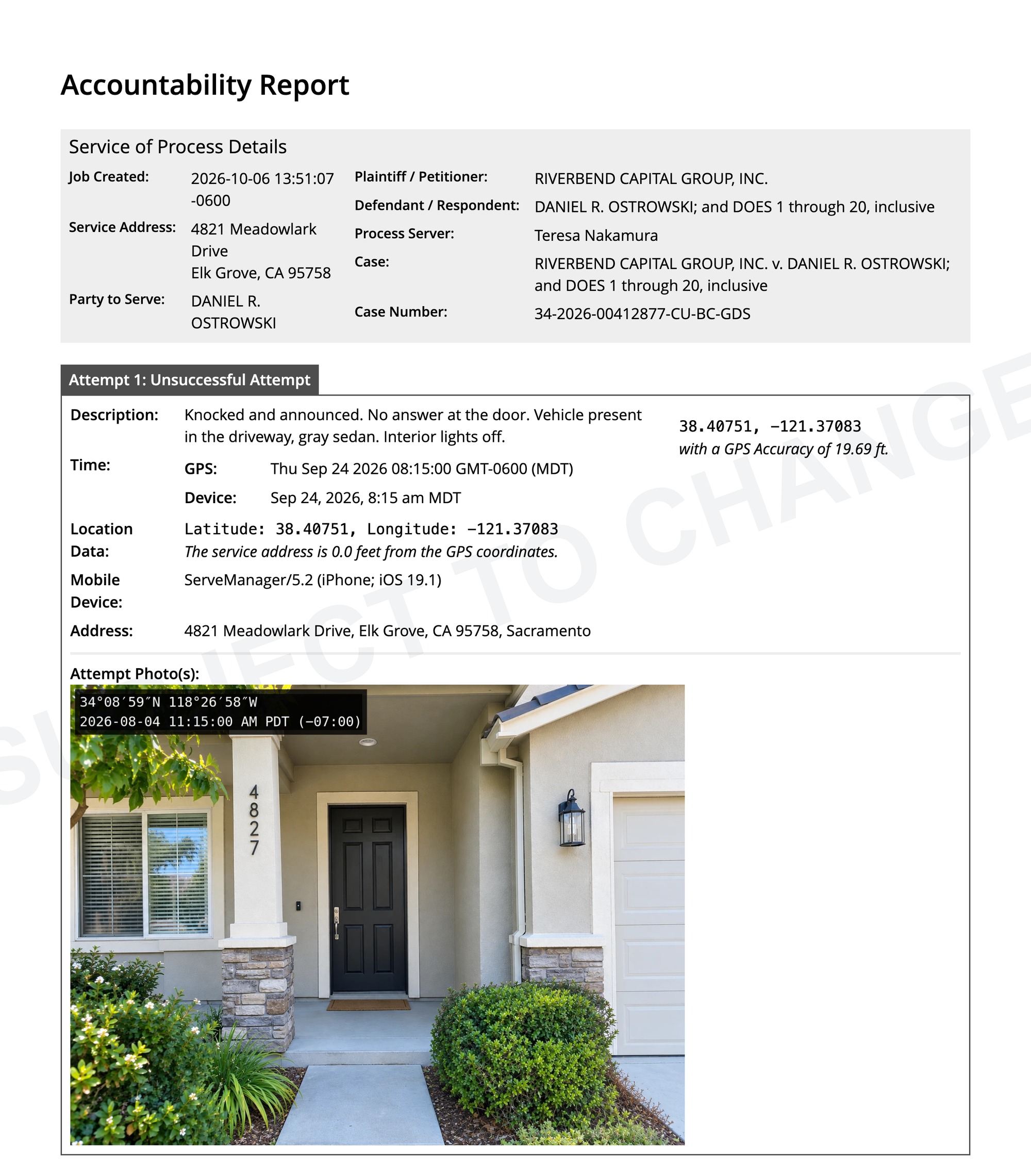
Questions to ask a process server
Before you hire a server for a California case filed on or after January 1, 2027, ask:
- Does your software take a photo with a date, time and GPS stamp on every attempt?
- Are those photos and details attached to the proof of service automatically?
- How do you record attempts where a photo isn't safe or there's no signal?
- How do you track the three-attempt rule, including a home attempt when one is required?
- Is your county registration number printed on the proof?
- Can I see the attempt records while the job is in progress?
If the answer to any of these is "we'll handle it by hand," keep looking.
Order SPARE Act-ready service here
Every agency you can choose in the ordering assistant on this page runs its jobs in ServeManager, process-serving software built to capture the records the SPARE Act calls for. That includes stamped attempt photos, GPS location, attempt history and the server's registration details.
In one guided conversation, the assistant lets you upload your documents, enter the recipient's details, choose an agency and service level, and pay. After you order, it keeps you updated on the job's status. There's no need to ask each agency the questions above.
Learn more
- AB 747 bill text (California Legislative Information)
- SPARE Act (AB 747) compliant process serving software (ServeManager blog: a closer look at each requirement)
- California process serving laws
- Find California courts
This article is a general overview, not legal advice. Talk to your attorney about how the SPARE Act applies to your case.
Need papers served?
Chat with our AI to book a process server near the recipient, get a price, or check on an order.