
Rules of civil procedure and service of process requirements for California.
Last updated October 22, 2026
California's rules for serving a summons and complaint are in the Code of Civil Procedure (CCP), mainly sections 413.10 to 417.40. Who can serve for pay, and how they register, is covered by the Business and Professions Code (B&P), sections 22350 and following.
The rules are changing. On January 1, 2027, the SPARE Act (AB 747) adds photo, GPS and attempt requirements to proof of service. This page covers the rules as they stand now and what changes in 2027.
Disclaimer: Laws change, and this page is a plain-language summary, not legal advice. Check the current code on California Legislative Information or ask an attorney before relying on it.
California process servers
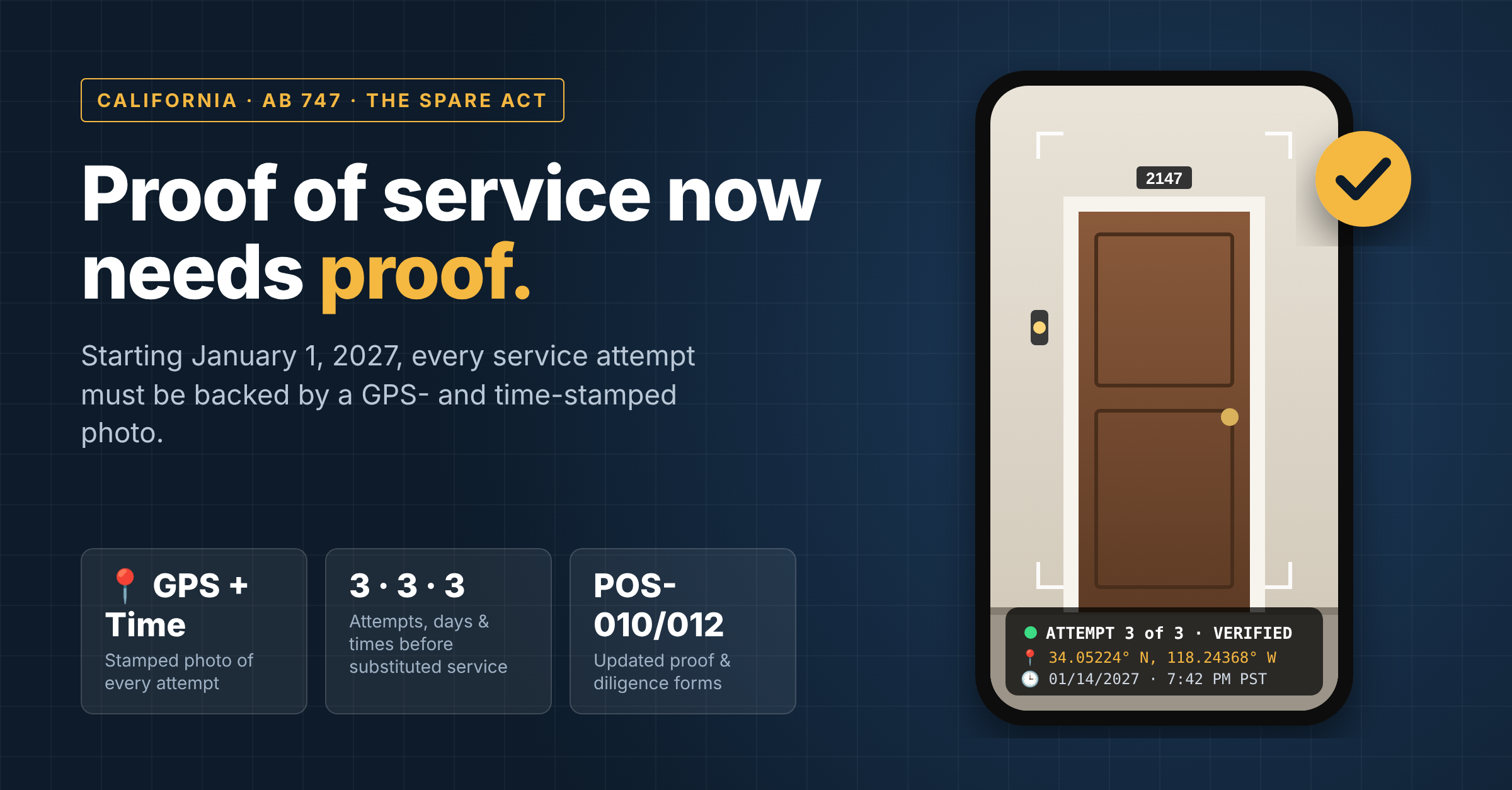
The Service of Process Accountability, Reform and Equity Act (AB 747, Chapter 563, Statutes of 2025) was signed on October 10, 2025. It's meant to stop "sewer service," where papers are never actually delivered. Most of it takes effect on January 1, 2027.
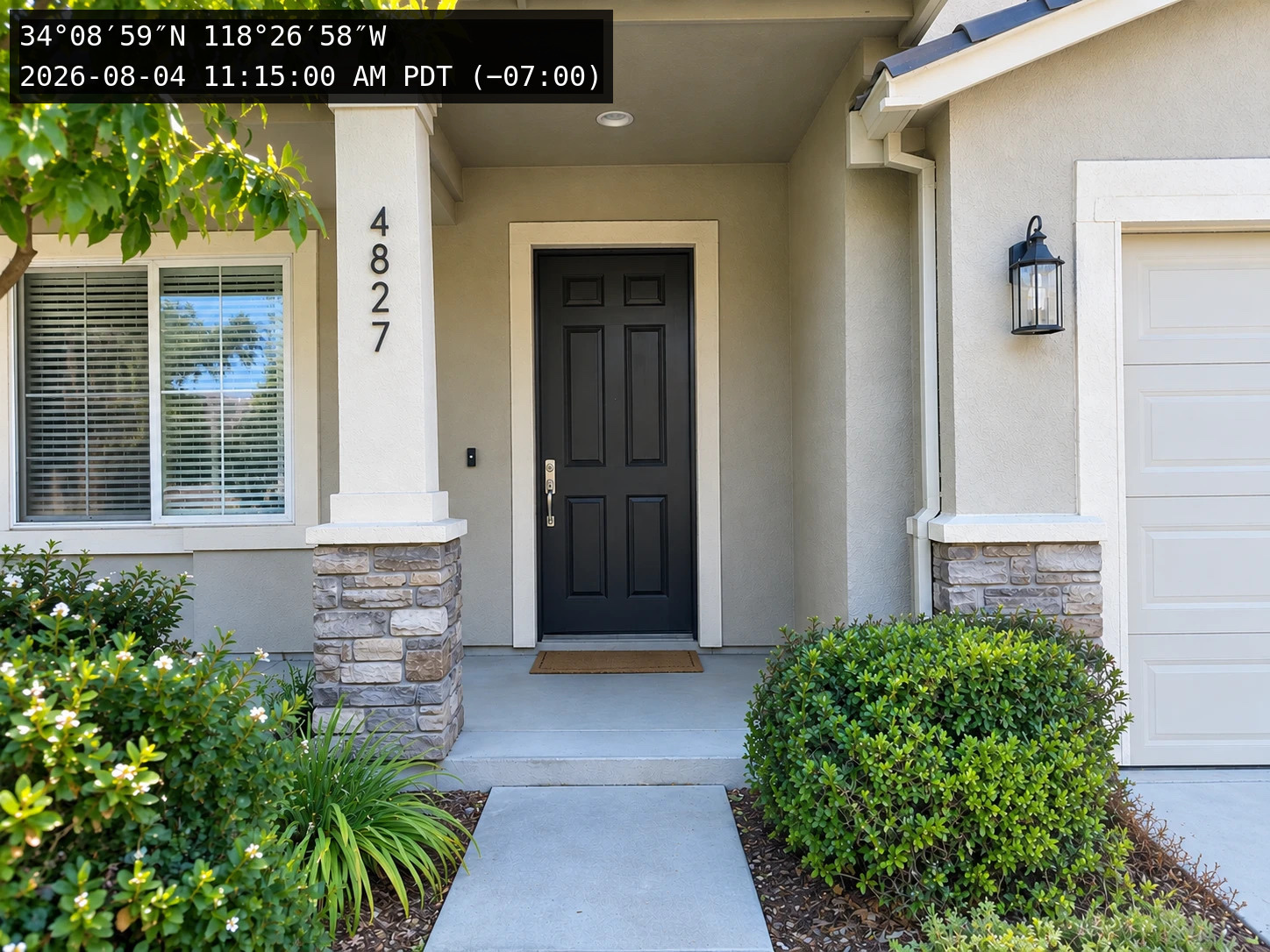
The SPARE Act doesn't add photo requirements to service by mail with acknowledgment or service by publication.
For more detail, read our guide for people hiring a server, California's SPARE Act: What to Know Before You Hire a Process Server, and ServeManager's requirement-by-requirement breakdown, SPARE Act (AB 747) compliant process serving software.
Built for the SPARE Act: ServeManager
ServeManager is process-serving software that captures what California's new rules call for at the moment of each attempt:
- Attempt photos with the date, time and GPS burned into the image
- A running count of the three-attempt rule across every server on a job
- Prompts for safety and no-signal explanations at the time of the attempt
- Your county registration number printed on California proofs
- Proofs of service generated from the job, with photos and GPS attached
California registers process servers rather than licensing them. Under B&P § 22350, anyone who makes more than 10 services of process in California in a calendar year for pay must register with the county clerk where they live or have their main place of business. Businesses that earn money from serving process must register too.
To register, you'll generally need to:
Registration lasts two years (B&P § 22354). Some people are exempt, including licensed private investigators and their employees, and attorneys and their staff. For a step-by-step guide, see Become a Process Server in California.
The server hands a copy of the summons and complaint directly to the person being served. Service is complete at the time of delivery.
If the person can't be served in person after reasonable diligence, the server can leave the papers with a competent adult (18 or older) at the person's home, usual mailing address (not a USPS post office box) or usual place of business, and tell them what the papers are. The server then mails a copy to the same address. Service is complete on the 10th day after mailing.
For a business or public entity, papers can be left during office hours with the person apparently in charge of the office, followed by mailing.
Starting January 1, 2027, reasonable diligence means three attempts on three different days at three different times, as described in the SPARE Act section above.
The summons and complaint are mailed with two copies of a Notice and Acknowledgment of Receipt and a return envelope. Service is complete when the person signs the acknowledgment. If they don't return it within 20 days, they may have to pay the cost of serving them another way.
A person outside California can be served by any method above, or by first-class mail with a return receipt. Mail service is complete on the 10th day after mailing. Service outside the United States is subject to the Hague Service Convention where it applies (CCP § 413.10).
In an eviction case, if the tenant can't be served with reasonable diligence, the court can order the summons posted on the property and mailed. Starting in 2027, this also requires three attempts, including one at the home for residential property.
If the person can't be found with reasonable diligence, the court can order the summons published in a newspaper. This requires a court order and a declaration describing the efforts made to find the person. See What is service by publication?
If no statute covers the situation, the court can order service in any way reasonably likely to give the person actual notice.
A gated community with a guard on duty must let a process server in for a reasonable time to serve papers. The server must show a current driver's license or other ID, plus proof of registration as a process server or a private investigator license. Sheriffs, marshals and certain government investigators can show a badge instead.
After service, the server completes a proof of service showing who was served, and the time, place and manner of service. Personal service must be proved on the Judicial Council form (POS-010 in most civil cases).
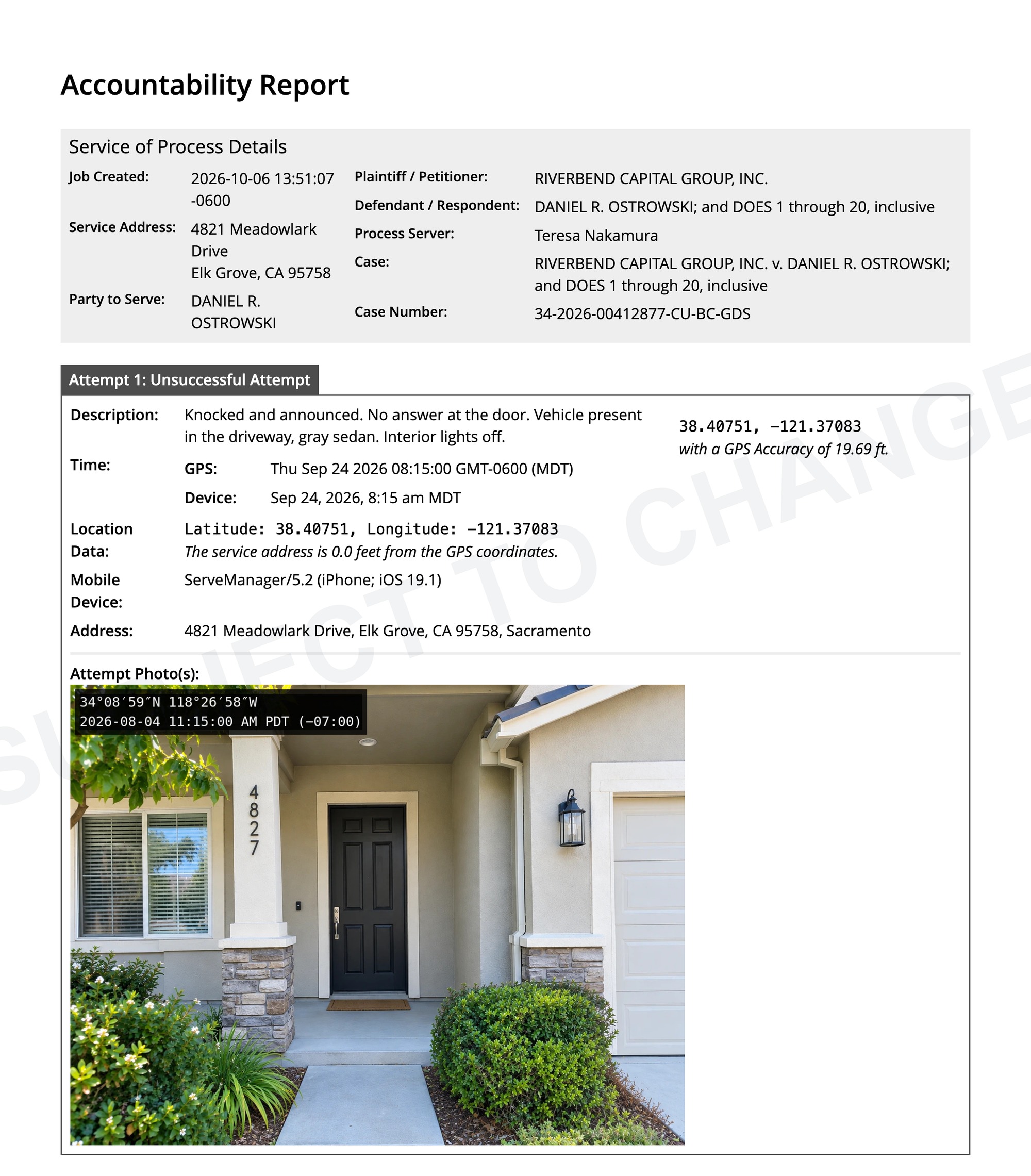
A proof can be signed as a declaration under penalty of perjury instead of being notarized (CCP § 2015.5). A proof signed by a registered process server is presumed to be true, though under the SPARE Act that presumption can be rebutted.
A registered server's proof must show their registration number. Starting January 1, 2027, it must also include the stamped photos and any written explanations described above.
Looking for a server who's ready for the SPARE Act? Find agencies in Los Angeles, San Jose, Sacramento, Fresno, Long Beach and Bakersfield.
This page is a general overview of California law, not legal advice. Laws change. Check the current code or talk to an attorney about your case.
Chat with our AI to book a process server near the recipient, get a price, or check on an order.