
What Is a Process Server? What They Do and Who Can Be One
Last updated October 28, 2026
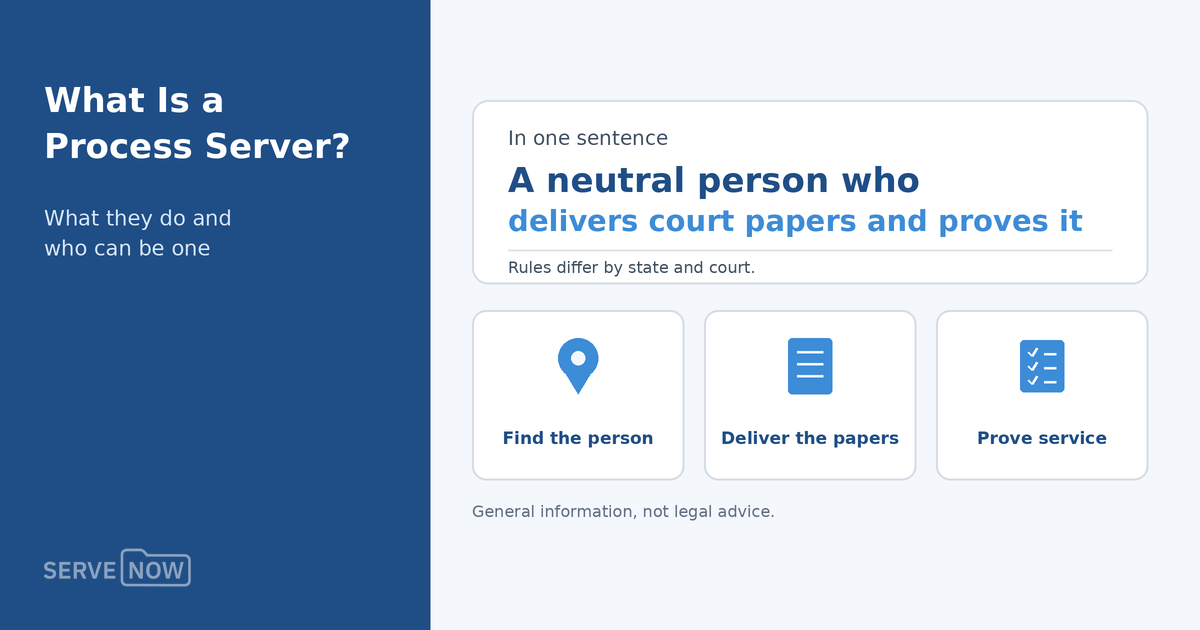
A process server is a person who delivers legal papers, such as a summons, a complaint or a subpoena, to the person named in them, and then proves to the court that it was done. The person doing the delivering is not part of the case. That is what makes the notice count.
Most people never think about process servers until they need to serve papers or have been served. This guide explains what a process server does, what they serve, who can be one, and how to find one.
What does a process server do?
A process server's main job is to get court papers to the right person in the way the law requires. In practice that means:
- Receive the papers from a law firm, a business or a person involved in the case.
- Find the person. If the address is old or incomplete, many servers use skip tracing to find a current one.
- Deliver the papers in the way the court's rules allow. That may be handing them to the person, or in some cases leaving them with another adult at the home or workplace. Some rules allow other methods only with a court order.
- Make more than one attempt when the person isn't there, at different times of day, and note each try.
- Prove service. The server completes a signed statement, called an affidavit of service or proof of service, that gives the date, time, place and manner of service and who received the papers. That proof is filed with the court.
Process servers may also file court papers, pick up records and handle other legal support tasks, depending on the firm.
What papers does a process server serve?
Common examples are:
- A summons and complaint that start a lawsuit
- Subpoenas for testimony or records. See how to serve a subpoena.
- Divorce and family court papers. See how to serve divorce papers.
- Eviction notices. See how to serve eviction notices.
- Orders and notices in small claims, foreclosure and other cases
Who can be a process server?
It depends on where the case is. In federal court, any person who is at least 18 and not a party to the case may serve a summons and complaint. States set their own rules. Some require a license, registration or certification. Some require an appointment by the court. Many, like Colorado, have no license at all and allow any adult who isn't a party to serve.
A party to the case generally can't serve their own papers. See which states require a process server license and our state-by-state guide to process serving laws for the rules where you are.
A process server also has limits. They are not law enforcement, cannot force their way in, and cannot give legal advice. Read what process servers can't do.
Why does service of process matter?
A court generally can't decide a case against a person who was never properly told about it. In the United States, the right to notice before the government takes away life, liberty or property comes from the due process clauses of the Fifth and Fourteenth Amendments. Service of process is how that notice is delivered in a civil case.
If service is done wrong, the person served can ask the court to throw it out, which can delay the case or lead to dismissal. For the history behind these rules, from medieval summoners to GPS-stamped photos, read The History of Service of Process.
Process server vs. sheriff
For many years the sheriff's office served most court papers, and sheriffs and constables still serve in many places. Private process servers handle much of the rest. A private server can often work on your schedule, make repeated attempts, and take rush jobs. See process server vs. sheriff for a comparison.
How technology has changed the job
Servers now use software to log each attempt with the date, time and GPS location, and some take photos. Some places require it. New York City requires process servers to use an electronic device that records GPS location and time, and California's SPARE Act, effective January 1, 2027, asks for photo, time and GPS records of each attempt. Read what the SPARE Act means before you hire a process server.
How to hire a process server
Choose a server who covers the area where the person lives or works, and tell them your deadline. Search the ServeNow directory by city or ZIP code, or order service with the ServeNow AI assistant: upload your documents, enter the recipient's details, choose a credentialed agency and pay. You can also call (877) 737-8366. For more tips, see how to hire a process server.
If you are a process server

ServeManager is process serving software that tracks jobs and attempts and creates affidavits of service. Start a 14-day free trial (no credit card required).
Related reading
- What is an affidavit of service?
- Substituted service
- How long you have to serve papers after filing a lawsuit
- How to hire a process server
This article is a general overview, not legal advice. Service rules depend on the court and the state.
Need papers served?
Chat with our AI to book a process server near the recipient, get a price, or check on an order.