
How to Serve Divorce Papers: A Step-by-Step Guide
Last updated October 22, 2026
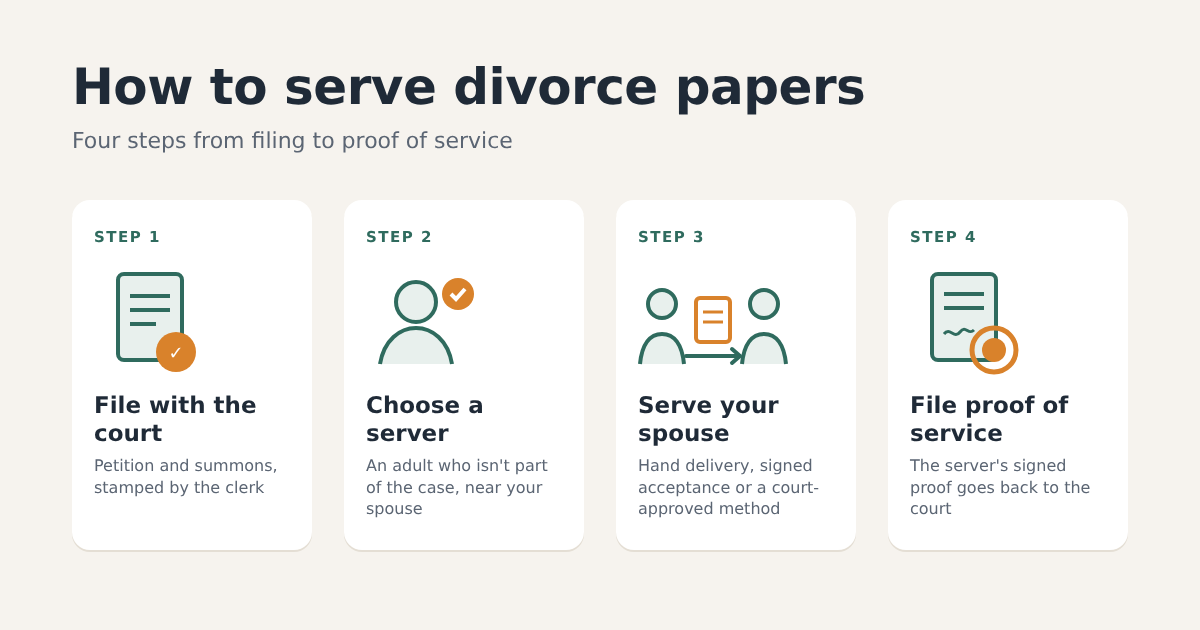
After you file for divorce, your spouse has to be formally given copies of the papers. This is called service of process. The court won't move your case forward until service is done the right way and you've filed proof of it.
Ready to order? You can hire a process server with the ordering assistant on this page. It walks you through uploading your papers, entering your spouse's details and choosing an agency.
The rules below are general. Each state, and sometimes each county, sets its own. Your court's self-help center or an attorney can tell you exactly what applies to your case.
Step 1: File your divorce papers
Divorce starts with a petition (some states call it a complaint) filed with the court in the county where you or your spouse lives. The petition says who is in the marriage, what you're asking for (such as property division, support or custody) and the grounds for divorce.
When you file, the clerk stamps your papers and issues a summons. The summons is a separate document. It tells your spouse a case has been filed and how long they have to respond. Keep the originals and make copies to serve.
Step 2: Know what papers to serve
You'll usually serve your spouse with copies of:
- The filed petition or complaint
- The summons
- Any other forms you filed, except fee waiver forms
- A blank response form, if your state requires one
- Any court orders or notices issued with the summons, such as automatic restraining orders in some states or a temporary hearing date
Your court's checklist or self-help center can confirm the full set. California, for example, lists what to serve on its Serve your divorce papers page.
Step 3: Decide how your spouse will be served
If your spouse is cooperative
Many states let your spouse sign a form saying they received the papers, often called an acknowledgment of service, acceptance of service or waiver of service. Ask your court which form to use. If your spouse won't sign, or won't return it in time, you'll need to have them served another way.
Personal service
In most divorces, someone hands the papers directly to your spouse. You can't serve them yourself. In most states, the server must be an adult who isn't part of the case. Your options are usually:
- A professional process server. They serve papers every day, know the local rules and can make repeated attempts at different times.
- The sheriff or constable. Many counties offer this for a set fee, which may be waived if you qualify for a fee waiver.
- A friend or relative over 18, where your state allows it. This is free but can put them in an awkward spot, and they have to fill out the proof of service correctly.
Hire a server who works where your spouse lives, not where you live.
If your spouse can't be found or avoids service
A process server can try different times and places, including work. If they still can't reach your spouse, they'll document each attempt. You can then ask the court for permission to use another method, such as:
- Substituted service, leaving the papers with another adult at your spouse's home or work
- Service by mail
- Service by publication or posting
- Electronic service, such as email or text, in some states
You need a court order before using most of these. The number of attempts the court expects before it will allow them varies, so ask your server to keep detailed notes of every attempt.
If your spouse lives in another state, another country or is in the military
Out-of-state service usually follows the rules of the state where you filed, so hire a server in your spouse's area who knows them. Service in another country may fall under the Hague Service Convention and can take months. Different rules apply to active-duty service members.
Step 4: File proof of service
After serving your spouse, the server fills out a proof of service, sometimes called an affidavit of service. It records who was served, when, where and how. Depending on your state, it's signed under penalty of perjury or notarized.
You file the original with the court and keep a copy. Your spouse's deadline to respond usually starts from the date of service. Thirty days is common, but it varies by state.
How long do you have to serve divorce papers?
It depends on your state. Some courts expect service within 60 to 120 days of filing. Others have no fixed deadline but will dismiss a case that sits too long. If you've asked for a hearing, you'll also need to serve your spouse a certain number of days before it.
Serve as early as you can. That leaves time for extra attempts if your spouse is hard to reach.
How much does it cost to serve divorce papers?
Process server fees depend on where your spouse lives, how fast you need service and how many attempts it takes. Rush service, hard-to-find spouses and rural addresses usually cost more. Sheriff fees are set by the county.
Serving the papers is a separate cost from court filing fees and attorney fees. You can see agency pricing in the ordering assistant on this page before you order.
Where can divorce papers be served?
Anywhere your spouse can lawfully be found: at home, at work or in another public place. Papers can also be served on someone in jail or prison, usually through the facility. If your spouse isn't avoiding service, a home or other private setting is usually the least confrontational choice.
Give your server as much as you can: a recent photo, home and work addresses, vehicle details and the hours your spouse is usually home.
What happens after your spouse is served?
Your spouse can file a response by the deadline. If they don't, you may be able to ask the court for a default judgment. If they do respond, the case moves forward, often to financial disclosures, mediation, hearings or a settlement.
Because the rules differ so much from state to state, it's worth talking to a family law attorney or your court's self-help center about next steps.
Hire a process server for divorce papers
Use the ordering assistant on this page to hire a local process server. You can upload your documents, enter your spouse's details, choose an agency and service level, and pay in one conversation. You'll get updates on each attempt and the proof of service when the job is done.
Learn more
- Serve your divorce papers (California Courts self-help, an example of what your state's court may publish)
- What is an affidavit of service?
- Understanding substituted service
- What is service by publication?
- Find your court
- Process server glossary
This article is a general overview, not legal advice. Talk to an attorney or your court's self-help center about the rules for your case.
Need papers served?
Chat with our AI to book a process server near the recipient, get a price, or check on an order.