
Process Server License: Which States Require One?
Last updated October 23, 2026
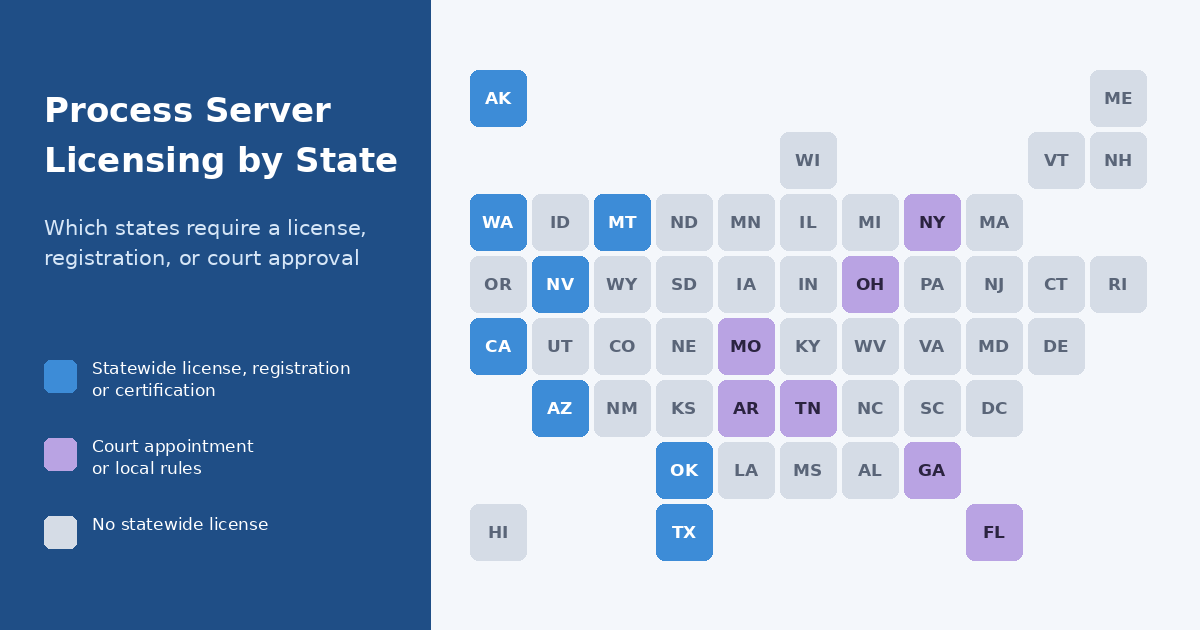 Reviewed October 2026. Licensing rules change often, so confirm with the state agency or court before you rely on this page.
Before you hire a process server, find out whether your state requires them to hold a license, register, or be approved by a court. The rule depends on the state, and sometimes on the county or city. Many states have no licensing at all, and the servers there are bound only by the court rules for service of process.
States with a statewide license, registration or certification
These states set one statewide requirement for process servers. Each link goes to that state's page on becoming a process server.
- Alaska: license from the Department of Public Safety.
- Arizona: statewide certification through the Arizona Supreme Court.
- California: registration in the county. See also what California's SPARE Act means for buyers.
- Montana: registration through the Department of Labor and Industry.
- Nevada: license under NRS Chapter 648.
- Oklahoma: statewide license.
- Texas: certification through the Judicial Branch Certification Commission.
- Washington: registration under RCW Chapter 18.180.
States that use court appointment or local licensing
Some states have no state license, but a court or local agency has to approve the server. Examples include Arkansas (appointment by the circuit court in each county), Ohio (a court order), Florida, Georgia, Missouri, Tennessee and New York, where New York City licenses servers through its Department of Consumer and Worker Protection.
For every other state, use the state-by-state guide to service of process laws to see who may serve papers and whether a court appointment applies.
Why the license matters when you hire a process server
Service of process is how a court knows the other side was told about the case. If the person who served the papers was not qualified, the other side can challenge the service. That can mean serving again, missing a deadline, or a delay in your case. A licensed or approved server has already met the state's rules on age, background and, in many places, insurance or a bond. Hiring one lowers that risk.
This matters most in the states listed above. In a state with no license, you still want a server who knows the local court rules and files a correct proof of service.
How to check a process server's credentials
If you use the ServeNow AI assistant to find a process server, every process serving agency it recommends is credentialed. If you hire a server some other way, check the credentials yourself:
- Ask for the license, registration or certification number and the agency that issued it.
- Look the number up on the state agency's website or call the court clerk.
- Ask whether the server carries insurance and whether they are approved to serve in the county where the person lives.
- Keep the signed proof of service the server files. Courts can reject service made by someone who was not qualified to make it.
What to do if the server was not qualified
If you find out after the fact that the server did not hold a required license or court appointment, do not wait for the other side to raise it. Tell your attorney or the court clerk, find out whether the court will accept the service as it stands, and be ready to serve again with a qualified server. Acting early costs less than finding out at a default hearing.
Do you need a license to become a process server?
It depends on where you plan to work.
- Statewide license, registration or certification: In the eight states listed above, you must apply to the state before you serve papers for others. Start with that state's page on becoming a process server.
- Court appointment: In states such as Arkansas and Ohio, a court has to approve you, sometimes county by county.
- No license: In many other states, you can serve papers if you meet the court rules. Most states set a minimum age and bar parties to the case from serving their own papers. The minimum age is usually 18, but some states differ. Alabama, for example, sets it at 19.
In federal court, Rule 4(c)(2) says any person who is at least 18 and not a party may serve a summons and complaint. Check your state's license rules too, because they can apply to you even when the federal rule does not.
The state-by-state guide to service of process laws lists each state's rules on who may serve.
For working process servers: renewals and other states
A license or registration is not permanent. Most programs renew on a set schedule and may ask for continuing education, a background check, proof of insurance or a fee. Texas is one example: certification lasts two years, and renewing takes 8 hours of approved continuing education (2 in ethics), a criminal history check and a fee. See the Judicial Branch Certification Commission renewal page for the current requirements.
A credential from one state does not carry over to another. Before you take a job in a new state, read that state's page on becoming a process server and check whether you need to apply there. Keep your certificate or registration number handy, since clients who check credentials will ask for it.
Frequently asked questions
Can a friend or family member serve papers for me?
In many states, yes, as long as they are an adult who is not a party to the case. Some states require a sheriff, a court-appointed server or a licensed server instead. Check your state's rule, and note that a server who is not neutral can make the service easier to challenge.
Can the sheriff serve papers instead of a process server?
In most states, yes. See Process Server vs. Sheriff for how the two compare.
Does a license in one state let me serve papers in another?
No. Each state sets its own rules, so check the state where the person will be served.
What if my state is not on the license list?
Then it has no statewide license, or the rule is set by the court or county. Check the state-by-state guide, or ask the court clerk in the county where the case is filed.
How do I know a process server is qualified?
Use the steps in the section on checking credentials above. If you search with the ServeNow AI assistant, every process serving agency it recommends is credentialed.
Find a local process server
ServeNow lists local process servers by city and ZIP code. Search the directory to compare servers near the person you need to serve, or contact us if you have a question.
Need papers served?
Chat with our AI to book a process server near the recipient, get a price, or check on an order.