
How to Serve a Subpoena: Rules, Fees and Proof of Service
Last updated October 28, 2026
ServeNow is not a law firm. If you need legal advice or help completing a subpoena, contact a lawyer or legal support professional. The federal rule below is Rule 45 of the Federal Rules of Civil Procedure. State rules differ.
A subpoena only works if the person named in it receives it the right way. If service is wrong, the recipient can ask the court to quash it, and you lose time you may not have. This guide explains how a subpoena is served, what to hand over with it, and how to prove it was done.
What is a subpoena?
A subpoena is a court order, usually issued through the court, that requires a person to do one of three things:
- Testify at a trial or hearing.
- Testify at a deposition, which is sworn questioning outside the courtroom.
- Produce documents or other items. This kind is called a subpoena duces tecum. It can also require permission to inspect a place.
One subpoena can combine these. Some state forms use different names, so read the form for your court.
Step 1: Get the subpoena issued
In federal court, the clerk can issue a signed subpoena, and an attorney authorized to practice in that court can also issue and sign one (Rule 45(a)). State courts have their own forms and rules. Use the form for the court where the case is pending, and keep a copy for your records.
Before serving, check the details that tend to cause problems later:
- Time to comply. The subpoena must give a reasonable amount of time.
- Place. In federal court, a trial, hearing or deposition generally has to be within 100 miles of where the person lives, works or regularly does business in person (Rule 45(c)).
- Burden. The party that issues a subpoena must take reasonable steps to avoid placing an undue burden or expense on the person who receives it.
Step 2: Give notice to the other parties
In federal court, if the subpoena asks for documents, electronically stored information or tangible things, or for inspection of a place, the issuing party must serve notice and a copy of the subpoena on every other party before serving the witness (Rule 45(a)(4)). Many states have a similar rule. Check yours.
Who can serve a subpoena?
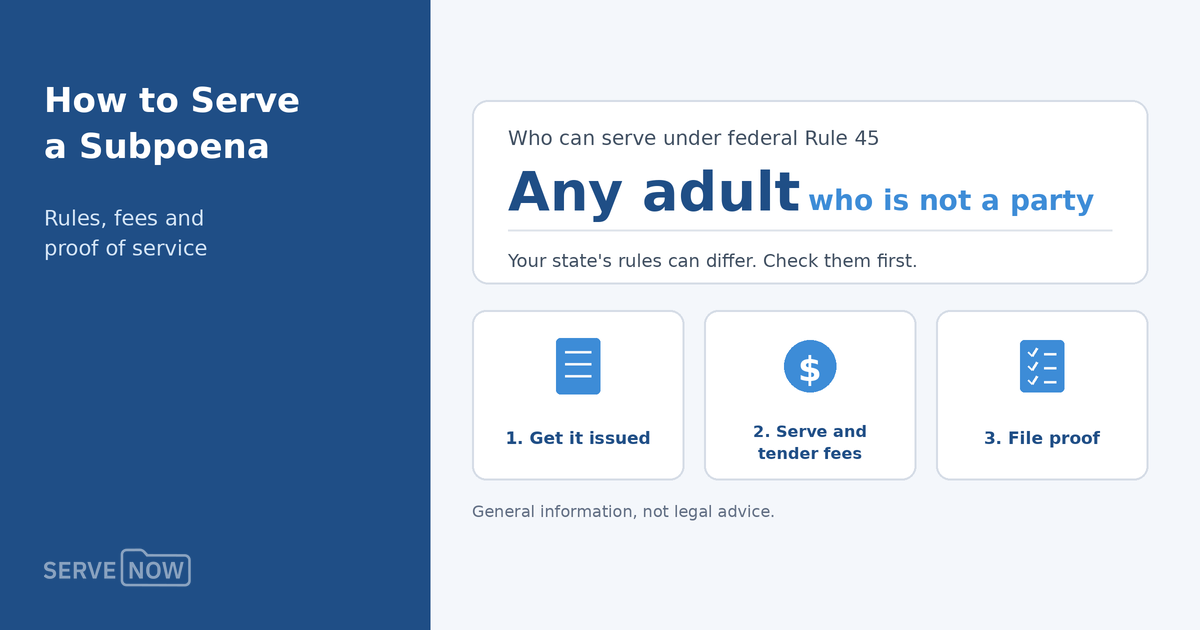
In federal court, any person who is at least 18 and not a party to the case can serve a subpoena (Rule 45(b)(1)). That means you cannot serve it yourself if you are a party. State rules vary. Colorado, for example, allows any adult who isn't a party to serve a subpoena (C.R.C.P. 45(b)). Some states require a sheriff, a constable or a licensed or appointed server for certain papers. Our state-by-state guide to process serving laws shows who may serve in each state.
Most people hire a professional process server. A server knows the local rules, can find people who are hard to find, keeps a record of each attempt, and prepares the proof of service for the court.
How is a subpoena served?
Under the federal rule, service is made by delivering a copy to the named person (Rule 45(b)(1)). In practice that means handing it to the person. It can be done anywhere in the United States (Rule 45(b)(2)).
The old advice that you can serve a subpoena by email, by mail or by reading it aloud is not safe to follow without checking your court. Some state rules and some judges allow mail, a signed acknowledgment or a waiver of service, and some do not. If you plan to use anything other than hand delivery, confirm it in the rule or get the court's approval first.
Tender the witness fee and mileage
If the subpoena requires the person to attend, you generally must offer the witness fee for one day and the mileage allowed by law when you serve it. In federal court that is required under Rule 45(b)(1), except when the subpoena is issued for the United States or one of its agencies. The federal witness fee is $40 for each day of attendance, plus mileage, under 28 U.S.C. § 1821.
State rules differ on the amount and the timing. In Colorado, for example, one day's mileage must be tendered at service or within a reasonable time after it, and before the appearance date. Check the rule for your state and court, and keep a record of what you tendered.
Deadlines for serving
Give the person enough time. Federal rules require a reasonable time to comply. Some states set a minimum. Colorado, for example, requires service at least 48 hours before a hearing or trial, 7 days before a deposition, and 14 days before records must be produced, unless a court orders otherwise. See our Colorado process serving laws for the details.
Prove that the subpoena was served
After service, the server completes a proof of service. In federal court that is a statement certified by the server that shows the date, the manner of service and the names of the people served, and it is filed with the issuing court (Rule 45(b)(4)). State rules may require an affidavit or an unsworn declaration, and some require a notary. Learn more in What is an affidavit of service?
If you receive a subpoena
A subpoena is a legal order. Do not ignore it, and do not destroy or change any documents it covers. Read it for the date, place and what it asks for. In federal court, a person who is served can:
- Object in writing to producing documents or allowing an inspection. The objection must be served before the compliance date or within 14 days after service, whichever is earlier.
- Ask the court to quash or modify the subpoena if it does not allow a reasonable time, requires travel beyond the limits, asks for privileged material, or imposes an undue burden (Rule 45(d)).
A person who is served and fails to obey the subpoena without an adequate excuse can be held in contempt by the court (Rule 45(g)). If you are thinking about objecting or about what you may have to produce, talk to a lawyer.
Common reasons a subpoena is challenged
- Improper service, such as service by someone who is a party, or without the required fee
- Not enough time to comply
- Privileged or confidential information
- A request that is vague or too broad
- Undue burden or expense
Hire a process server for your subpoena
ServeNow is a network of local, credentialed process servers. Search by city or ZIP code, or order service with the ServeNow AI assistant: upload your documents, add the recipient's details, choose an agency and pay. You can also call (877) 737-8366.
Related reading
- What is an affidavit of service?
- How to hire a process server
- Substituted service
- How to identify someone avoiding service
- How long you have to serve papers after filing a lawsuit
- Serving papers on holidays
This article is a general overview, not legal advice. Subpoena rules depend on the court and the state.
Need papers served?
Chat with our AI to book a process server near the recipient, get a price, or check on an order.