
How Much Does It Cost to Hire a Process Server?
Last updated October 30, 2026
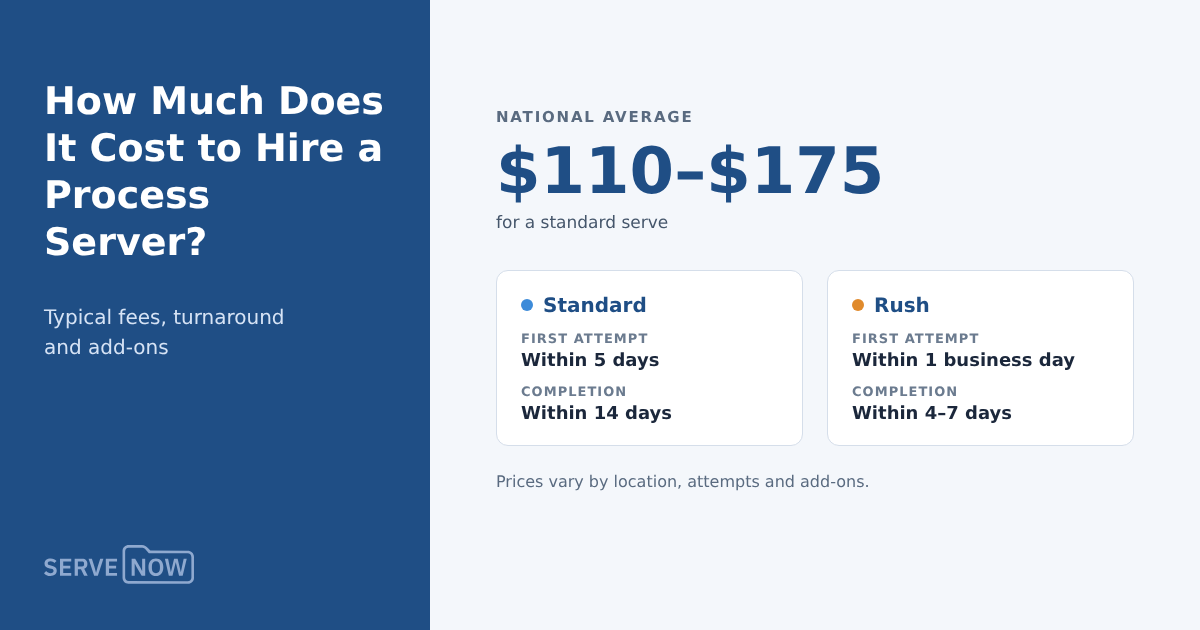
How much does it cost to hire a process server? Most people pay between $110 and $175 for a standard serve, which is the national average. A routine serve in some areas costs less than $110. A rush job, a hard-to-find recipient or a rural address can push the price to several hundred dollars.
This guide covers typical process server fees, what makes the price go up or down, which extra charges to ask about and how to get an accurate quote.
Need a price now? Use the ordering assistant on this page. Upload your papers or describe the serve, and it will find a process server near the recipient, show you the price and book the serve. You can also use it to check on an order you've already placed.
How much does a process server cost?
Prices vary by state, county, server and case. The ranges below are typical, not guaranteed. They give you a starting point for comparing quotes.
| Service type | Typical cost | Turnaround | Notes |
|---|---|---|---|
| Standard (routine) service | $75–$175 | First attempt within 5 days, completed within 14 days | Usually includes 2–4 attempts |
| Rush service | $100–$250 | First attempt within 1 business day, completed within 4–7 days | For short deadlines |
| Same-day or emergency service | $150–$300+ | Same day | Depends on the server's availability |
| Additional attempts | $20–$50 each | Varies | Only after the included attempts are used |
| Additional person at the same address | $25–$125 | Same as the main serve | Example: two defendants living together |
| Skip tracing (basic) | $35–$75 | Often same day | Database search for a current address |
| Skip tracing (complex) | $150–$400+ | Several days | For people who have moved or are hiding |
| Stakeout or wait time | $50–$175 per hour | As scheduled | Often a 2–3 hour minimum |
| Mileage | Per mile | N/A | Common for rural or out-of-area addresses |
| Notarized affidavit or extra copies | $15–$50 | N/A | Proof of service itself is usually included |
Orders placed through the ordering assistant on this page use two service levels:
- Standard: first attempt within 5 days of the order, and the job completed within 14 days.
- Rush: first attempt within 1 business day of the order, and the job completed within 4 to 7 days.
For most people, the standard price plus a few add-ons is what they end up paying. If you know where the recipient lives and they aren't avoiding service, you'll likely land near the national average or below it.
What affects the cost of serving papers?
The same set of papers can cost very different amounts to serve. These factors make the biggest difference.
- Location. Serves in cities are often cheaper per job because servers have more work nearby. Rural addresses take more driving, so many servers add mileage.
- Turnaround time. The faster you need the first attempt, the more you'll pay. Standard service costs the least. Rush service moves the first attempt up to the next business day.
- Number of attempts. Most quotes include a set number of attempts. If the recipient isn't home, each extra attempt can add to the bill.
- How hard the recipient is to reach. Someone who works odd hours, lives in a gated building or is avoiding service takes more time and more attempts.
- Number of recipients and addresses. Each person served is usually a separate fee. A second person at the same address often costs less than a second address.
- Type of documents. The price is usually the same for a summons, subpoena or notice. Some servers charge more for large document sets, or for subpoenas that come with a witness fee you have to supply.
- Individual vs. business. Serving a business through its registered agent is often simpler and cheaper. The agent is required to be available during business hours to accept papers.
What extra fees should I expect?
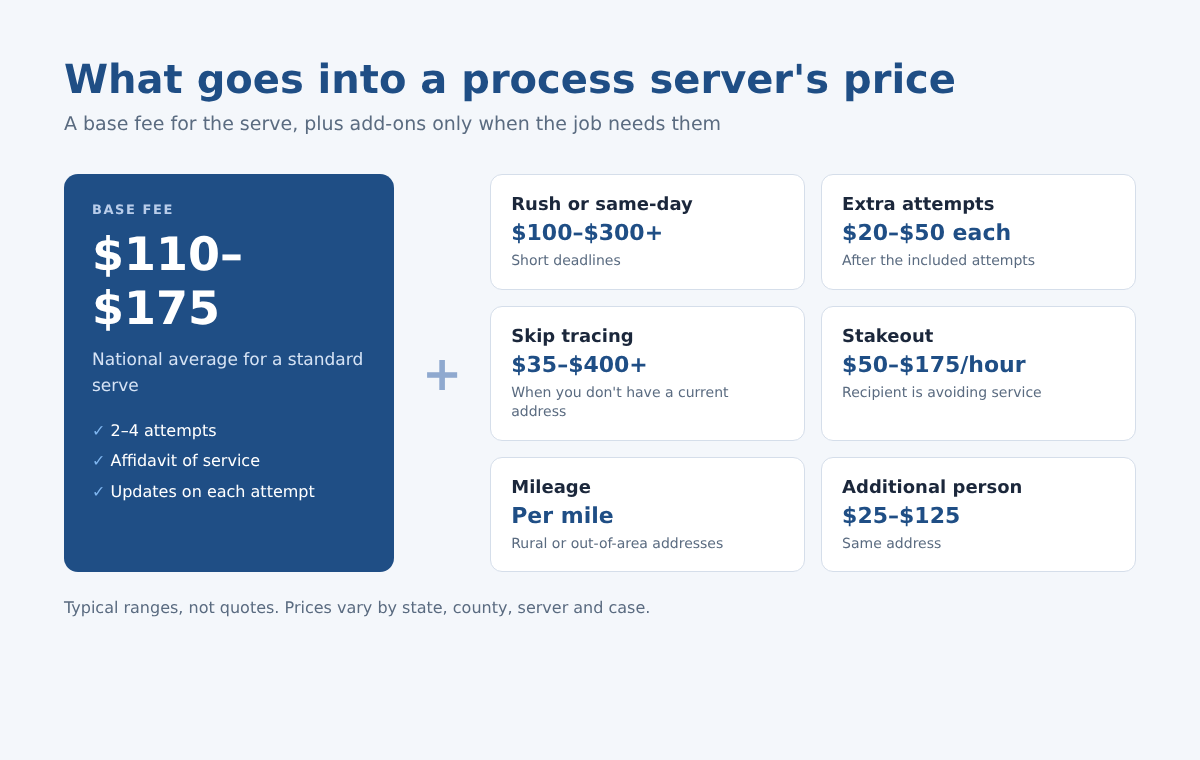
Many process server prices are quoted as a base fee plus add-ons. These are the ones that come up most often:
- Skip tracing. If you don't have a current address, the server may run a search to find one. A basic search is fairly cheap. A harder locate costs more. Our guide to skip tracing explains how it works.
- Stakeouts. For a recipient who is clearly avoiding service, a server may wait outside a home or workplace. This is usually billed by the hour with a minimum.
- Extra attempts. Once the included attempts are used, each additional attempt is billed separately.
- Mileage. Many servers charge per mile past a set distance. The per-mile rate is often based on the IRS standard mileage rate.
- Rush surcharges. Some servers quote rush and same-day work as a flat price. Others add a surcharge to the routine fee.
- Notarization. Proof of service is normally included. Some servers charge extra to notarize it, or for extra copies.
- Printing and copies. If you send files electronically, the server may charge to print them.
Before you hire anyone, ask what the base price includes and what would cost extra. A low quote that leaves out attempts or the affidavit can end up costing more than a higher, all-in price.
How much does it cost to serve divorce papers?
Serving divorce papers usually costs about the same as serving any other court documents. The price depends on where your spouse lives, how fast you need it done and how many attempts it takes. A spouse who avoids service will raise the cost, the same as with any recipient.
Keep in mind that the serve is a separate cost from court filing fees and attorney fees. For the full process, see our guide on how to serve divorce papers.
How much does it cost to serve small claims papers?
The same pricing applies to small claims cases. A standard serve to a known address usually falls within the typical range above. Our guide on how to serve small claims forms covers the steps.
Depending on the court, you may also be able to have the sheriff serve the papers. Check your court's small claims instructions to see which methods it allows. If the hearing date is close, or the person you're suing is likely to dodge service, a private process server is usually the more reliable choice.
Process server vs. sheriff: which costs less?
Each option has trade-offs.
- Sheriff or constable. Many sheriff's offices serve civil papers for a fee set by the county. That fee is often lower than a private server's, and it varies a lot from place to place. Sheriffs handle civil service alongside their other duties, so they may make fewer attempts and work on a slower schedule.
- Private process server. Often costs more than the sheriff. In return, you get faster turnaround, attempts at different times of day, and detailed notes on each attempt.
When you have a deadline or a recipient who is hard to reach, a private server is often the better value. A slow or failed serve can push back your court date, and that delay usually costs more than the difference in fees. Our process server vs. sheriff comparison looks at speed, success rate and cost side by side.
How do I get an accurate process server quote?
The fastest way to get an exact price is the ordering assistant on this page. Upload your papers and it reads them for you, fills in the case and recipient details, and matches you with a vetted server near the recipient. You'll see the price for standard or rush service before you order, with no calls or waiting on quotes. When you're ready, you can book and pay in the same conversation.
If you'd rather contact servers yourself, know that the more detail you give, the more accurate the quote. Have the recipient's name, address and any other known locations ready, along with your court deadline. Then ask:
- What's your turnaround time for the first attempt?
- How many attempts are included, and at what times of day?
- Is the affidavit of service included? Is notarization extra?
- Do you charge mileage, and from where?
- What are your rates for skip tracing and stakeouts if they're needed?
- How will you update me on each attempt?
Our hiring a process server checklist has more questions, and our guide on how to hire a process server covers what to look for in a server.
How can I save money on process serving?
A few steps can keep the cost down without risking the serve.
- Hire a server local to the recipient. A server who lives and works near the address doesn't need to charge mileage or travel time. If you go through a national company or your usual server in another area, they often send the job to a local server anyway and add a markup, sometimes $50 to $200. Read more about the benefits of hiring a local process server.
- Choose standard service when you can. If your deadline allows, standard service is the cheapest option. Ordering early also leaves room for extra attempts. See how long you have to serve legal papers to check your deadline.
- Give the most accurate address you have. A wrong or old address can lead to wasted attempts and skip tracing fees.
- Describe the recipient. A recent photo, physical description and vehicle details help the server identify the right person on the first try.
- Share workplace and schedule details. Knowing when the recipient is usually home, or where they work, cuts down on attempts.
- Batch your serves. If you have several people to serve in the same area, ask about a lower price for sending them together.
- Compare quotes. Ask two or three servers for a quote, and make sure each one covers the same things.
Is a cheaper process server always better?
No. A serve that fails, or is done the wrong way, can mean delays, a new round of service or even a dismissed case. Those costs add up fast. An experienced server who knows the local rules and keeps good records is worth paying a little more for.
If you're not sure whether you need a professional at all, see do you need a professional process server? Every server on ServeNow is pre-screened, so you can compare prices without guessing who's qualified.
Frequently asked questions
How much does a process server charge per attempt?
Most process servers don't charge per attempt for the first few. The base price usually includes two to four attempts. After that, extra attempts typically cost $20 to $50 each. Ask how many attempts are included before you order.
Is the affidavit of service included in the price?
Usually, yes. The server fills out the affidavit of service, also called proof of service, after the papers are delivered. Some servers charge extra to notarize it or to file it with the court for you.
Who pays for the process server? Can I recover the cost?
The person who needs the papers served pays the server up front. Depending on the court and how the case turns out, you may be able to recover the cost as part of your court costs. In federal court, for example, a defendant who refuses to waive service without good cause can be ordered to pay the cost of service under Federal Rule of Civil Procedure 4(d). Check with your court or an attorney about the rules for your case.
How much is a same-day process server?
Same-day service typically costs $150 to $300 or more. The price depends on the location, how late in the day you order and whether a server is available. In some areas, same-day service isn't offered at all. If the next business day is soon enough, rush service is usually the cheaper choice.
How much does it cost to serve someone who is avoiding service?
It depends on how much extra work it takes. You may pay for added attempts at different times, stakeout time at $50 to $175 per hour and skip tracing if the person has moved. A difficult serve can cost several hundred dollars in total. If attempts keep failing, the server's notes can help you ask the court for another method, such as substituted service or service by publication.
Do process server prices differ by state?
Yes. Prices vary by state, and often by county. Local demand, travel distance, licensing requirements and how many servers work in the area all play a part. Serves in large cities are often cheaper than serves in remote areas.
How much does it cost to serve papers to a business?
Serving a business is often at the low end of the typical range. Most businesses have a registered agent who is required to accept papers during business hours, so the serve usually takes one attempt. Serving a specific employee or officer at a busy workplace can take more effort and may cost more.
Get a process server price today
ServeNow.com is a trusted network of local, pre-screened process servers. You can get a price in two ways:
- Use the ordering assistant on this page. Upload your papers, enter the recipient's details, see the price and book the serve in a few minutes.
- Search by city. Compare local process servers and request quotes directly.
Learn more
- How to hire a process server
- Hiring a process server checklist
- Benefits of hiring a local process server
- Process server vs. sheriff
- What is skip tracing?
- What is an affidavit of service?
- How to serve divorce papers
- How to serve small claims forms
- Frequently asked questions
Prices in this article are general ranges, not quotes. They vary by location, server and case. This article is not legal advice. Check with your court or an attorney about the rules that apply to you.
Need papers served?
Chat with our AI to book a process server near the recipient, get a price, or check on an order.