
How Long Do You Have to Serve Legal Papers? Service Deadlines Explained
Last updated October 26, 2026
Filing a lawsuit is only the first step. The court also expects you to deliver the papers to the other side within a set amount of time, and to prove you did. If you wait too long, the court can dismiss your case.
This guide explains how service deadlines work, lists the deadline for every state and the District of Columbia, and shows how to line up a process server early enough to meet it.
The short answer
There is no single national deadline. Each court system sets its own, and in most places the clock starts when the case is filed.
- Federal court: 90 days after the complaint is filed.
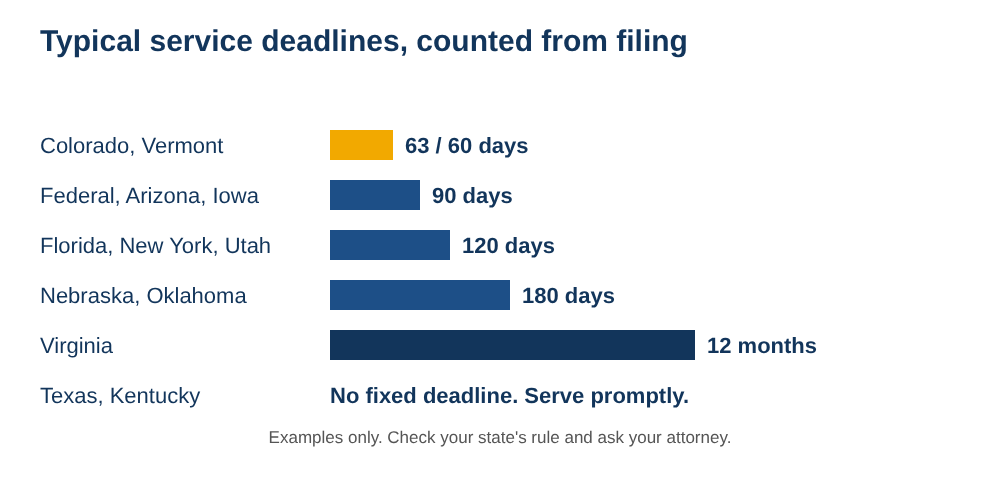
- Most states: between 60 and 180 days after filing. Some states give a year or more, and a few set no fixed number of days.
- Some states count differently. They may count from the day the summons is issued, limit how long a summons stays valid, or only apply a deadline when a statute of limitations is close.
The deadline is for completing service, not for starting to look for a server. Plan on having papers in a server's hands within a few days of filing.
Federal court: 90 days
Under Federal Rule of Civil Procedure 4(m), if a defendant has not been served within 90 days after the complaint is filed, the court must either dismiss the case against that defendant without prejudice or order that service be made within a set time.
If you can show good cause for the delay, the court must extend the time for an appropriate period. The rule does not apply to service in a foreign country under certain parts of Rule 4.
"Without prejudice" means you can usually refile. But a refiled case can run into the statute of limitations, and you will pay filing fees again. Meeting the deadline the first time is cheaper.
Our page on the Federal Rules of Civil Procedure has more on how federal service works.
Service deadlines by state
The table below summarizes each state's rule for state trial courts. Click a state name for its full process serving laws page, which has the rule citations and links to the court rules. Deadlines can differ by court, case type and county, and rules change, so confirm with the court clerk or your attorney before you rely on a date.
| State | Deadline to serve |
|---|---|
| Alabama | 120 days after filing, or the court may dismiss without prejudice. A process server has 60 days from issuance to serve or return the process. |
| Alaska | The court reviews service 120 days after filing. If a defendant is not served, the plaintiff gets 30 days to show good cause or that defendant is dismissed. |
| Arizona | 90 days after filing. |
| Arkansas | 120 days after filing, unless the court extends it for good cause. |
| California | Within 3 years of filing. Court rules expect defendants to be served and proof filed within 60 days of filing (Rule 3.110). |
| Colorado | 63 days after filing. |
| Connecticut | Serve at least 12 days before the return day, which can be no more than two months after the date of the process. File the return at least 6 days before the return day. |
| Delaware | 120 days after filing. |
| District of Columbia | File proof of service within 60 days after filing, unless the court extends the time. |
| Florida | 120 days after the initial pleading is filed. |
| Georgia | The server must serve within 5 days of receiving the papers, though later service is not invalid because of the delay. Proof is due within 5 business days of service. |
| Hawaii | A circuit court case can be dismissed if no service is made within 6 months of filing. |
| Idaho | 182 days after filing. |
| Illinois | A summons must be served within 30 days of its date. After that you can get an alias summons, but the case can be dismissed if you do not use reasonable diligence. |
| Indiana | No fixed number of days, but serve promptly. A case with no action for 60 days can be dismissed after a hearing. |
| Iowa | 90 days after the petition is filed. |
| Kansas | 90 days from filing for the case to count as started on the filing date. The court can add 30 days for good cause. The return is due within 14 days after service. |
| Kentucky | No fixed number of days. |
| Louisiana | Request service on every defendant within 90 days after the case starts. From August 1, 2026, the clerk's service fees must also be paid on time. |
| Maine | If you file first, file the return of service within 90 days after filing. If you serve first, file the complaint within 20 days after service. |
| Maryland | A circuit court summons is good for 60 days after it is issued. If it expires, ask the clerk to renew it. |
| Massachusetts | 90 days after filing, unless you show good cause. |
| Michigan | A summons expires 91 days after it is issued. With due diligence, a judge can order a second summons good for up to one year from the original. |
| Minnesota | No fixed deadline, because the case starts when the papers are served. Once started, the case must be filed within one year or it is deemed dismissed with prejudice. The one-year rule does not apply to family cases. |
| Mississippi | 120 days after filing, unless you show good cause. |
| Missouri | Serve promptly. A summons that cannot be served must be returned within 30 days after it is issued, and the court can extend that to 90 days. |
| Montana | 3 years after filing. |
| Nebraska | 180 days after filing, or the case is dismissed automatically as to that defendant. Proof for personal or residence service is due within 20 days after the summons is issued. |
| Nevada | 120 days after filing, unless the court extends it. |
| New Hampshire | By the service date the court sets on the summons. File the return within 21 days after that date. |
| New Jersey | No fixed number of days. Cases left unserved can be dismissed, so serve promptly. |
| New Mexico | No fixed number of days. Service must be made with reasonable diligence. |
| New York | 120 days after filing. For substituted service, mail within 20 days and file proof within 20 days of the delivery or mailing, whichever is later. |
| North Carolina | 60 days after the summons is issued. An endorsement or an alias or pluries summons within 90 days can keep it alive. |
| North Dakota | Rule 4 sets no deadline for ordinary service. The case starts when the summons is served, so the statute of limitations is the practical limit. |
| Ohio | 6 months after filing, unless there is good cause. This does not apply to out-of-state or foreign service. |
| Oklahoma | 180 days after the petition is filed, unless you show good cause. |
| Oregon | Serve within 60 days of filing for the case to count as started on the filing date for the statute of limitations. If no proof is filed by day 63, the court sends a notice of dismissal. |
| Pennsylvania | 30 days after the writ is issued or the complaint is filed if service is in Pennsylvania, and 90 days if it is outside Pennsylvania. Process can be reissued or reinstated. |
| Rhode Island | 120 days after the case starts in Superior Court, and 365 days in District Court. |
| South Carolina | No fixed deadline in Rule 4. If the statute of limitations runs before service, the case counts as started on filing only if service happens within 120 days after filing. |
| South Dakota | No fixed deadline, but the case does not start until service is made. If the summons is given to the sheriff to protect a limitations deadline, it must be served or first published within 60 days. |
| Tennessee | A summons not served within 90 days of issuance must be returned unserved. In general sessions court the limit is 60 days. |
| Texas | No fixed deadline. If a statute of limitations is close, the plaintiff must use diligence to get the defendant served. |
| Utah | 120 days after filing, unless the court sets a different time. |
| Vermont | Generally within 60 days after the complaint is filed. |
| Virginia | Within 12 months after the case is filed. Later service counts only if the court finds you used due diligence. |
| Washington | If you file first, serve at least one defendant within 90 days to protect the statute of limitations. If you serve first, file within 90 days of service. |
| West Virginia | 120 days after filing, unless the court extends it for good cause. |
| Wisconsin | 90 days after the summons and complaint are filed. |
| Wyoming | 90 days after filing, unless the court extends it for good cause. |
A few notes on reading the table:
- "No fixed deadline" does not mean "no deadline." Courts can still dismiss a case when the plaintiff has not tried hard to serve, and a statute of limitations can run out while the papers sit.
- Some deadlines protect the statute of limitations only. In states like Oregon, South Carolina and Washington, a late serve may still be valid, but you can lose the filing date you were counting on.
- Local and special rules apply. Eviction, small claims, family and collection cases often have their own timelines. Ask the court clerk.
If your case is in California, the rules for documenting service are also changing. See what the SPARE Act means when you hire a process server.
What counts as "served"
The deadline is met when the papers are properly delivered and the proof is on file. Delivery alone is not enough if the method was wrong.
- Personal delivery is handing the papers to the person being served. It is the method courts trust most.
- Substituted service means leaving the papers with another adult at the person's home or workplace, and often mailing a copy as well. Most states only allow it after you have tried personal delivery. Read more about substituted service.
- Proof of service is the signed statement from the server that says who was served, when, where and how. Courts call it an affidavit of service in many places. Your server prepares it, and you file it with the court.
In federal court, any adult who is not a party to the case may serve the papers. Many state courts have their own rules, and some require a licensed or registered process server. See which states require a process server license.
Why papers get served late
Most missed deadlines come from a few common problems:
- Waiting to order. People file, then spend weeks deciding who to hire.
- A bad address. The defendant moved, or the address is a mailbox or an old record.
- An avoider. Some people see a server coming and do not answer the door. Servers have ways to handle this, but it takes more attempts and more days. Our guide to how to identify someone avoiding service covers the signs.
- Out-of-state defendants. You need a server in the right place who knows the local rules. See how to have legal documents served in another state.
- Rejected or late proof. The server delivered the papers, but the proof was missing details or never got filed.
How to protect your deadline
- Calculate your deadline the day you file. Write down the date. Check whether your state counts from the filing date or from the date the summons is issued.
- Order service right away. Send the papers to a server the same week you file. Do not wait for the last month.
- Give the server good information. Include the full name, every known address, work hours, a description or photo if you have one, and any safety concerns. If you do not have a current address, a skip trace can help find one.
- Ask for a rush serve when time is short. Many servers offer faster service for an added fee. Ask about price and timing before you order.
- Ask for updates. Pick a server who tells you about each attempt, not just the result.
- File proof of service promptly. Check what your court requires, and file as soon as you have it.
- Ask for more time before the deadline, not after. If service is proving hard, talk to your attorney or the court about an extension while you still have days left. Courts look for good cause, and a record of repeated attempts helps show it.
What to do if you are close to the deadline
Call a process server today and tell them the date. A good server will tell you whether they can meet it. If they cannot, ask for a referral rather than waiting. Keep copies of every attempt record the server gives you. If you end up asking the court for more time, those records show that you tried.
Then talk to your attorney or the court clerk about options. If you are representing yourself, the clerk cannot give legal advice, but they can tell you about local deadlines and forms.
Hire a process server before time runs out
ServeNow lists credentialed process servers who serve papers across the country. You can find a local process server by city or state, or use the ordering assistant to upload your documents, enter the recipient's details, choose an agency and a service level, and pay. After you order, it keeps you updated on the status of your job.
Not sure what to look for? Start with our guidelines on how to hire a process server and the hiring checklist.
This article is a general overview, not legal advice. Deadlines depend on the court, the type of case and your state's rules, and rules change. Talk to your attorney or the court clerk about the deadline in your case.
Need papers served?
Chat with our AI to book a process server near the recipient, get a price, or check on an order.