
The History of Service of Process
Last updated October 26, 2026
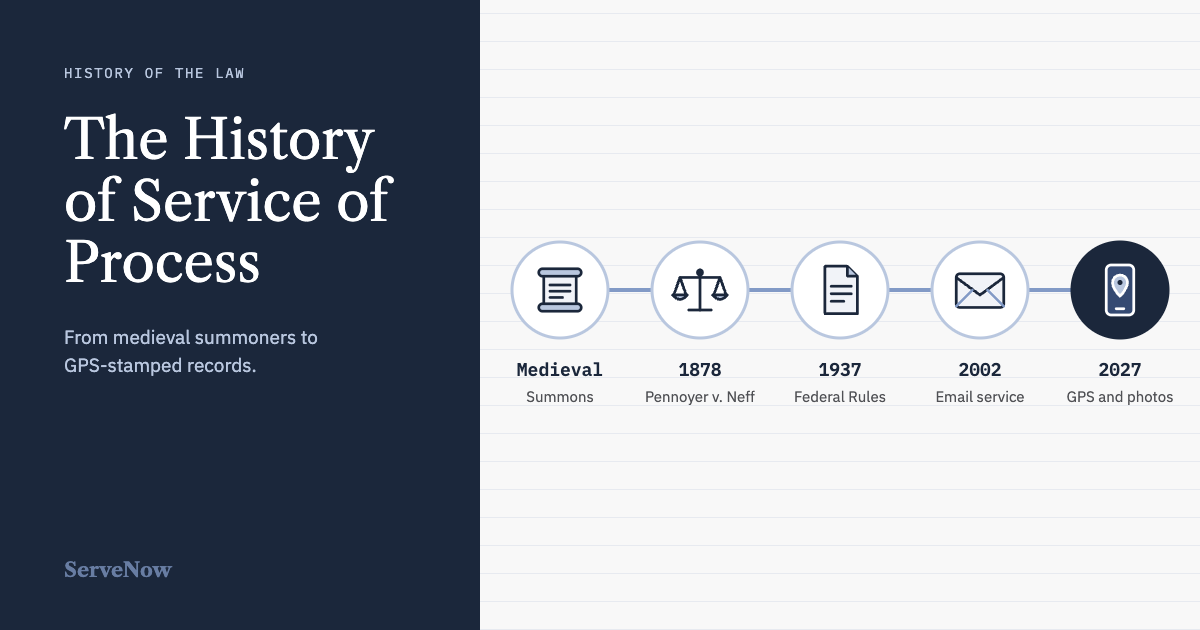
Service of process is the formal delivery of court papers to the person being sued or called to court. It looks simple. Someone hands over a document. But the rules behind that handoff took centuries to develop, and they are still changing.
This guide traces how service of process grew from a messenger sent by a sheriff to a record made of photos, timestamps and GPS coordinates. It also shows how technology has changed the job and where it is heading.
Why service of process exists
A court cannot decide a case against a person who does not know about it. Service of process is how the court makes sure the other side has been told. Every change in the history below comes back to the same two questions: how do you give someone real notice, and how do you prove you did?
The common law roots
Modern American service of process comes from English common law. In the Court of Common Pleas, a plaintiff first got an original writ. The sheriff then sent a messenger, called a summoner, to deliver a summons to the defendant in person or by leaving it at the defendant's home or on the defendant's land. The summons told the defendant to appear on a set day, called the return day, when the sheriff reported back to the court on what had been done. This account follows Blackstone's description of the process, as summarized by Letters Blogatory.
If the defendant did not appear, the court could issue stronger writs that led to seizing property or, in some cases, arrest. That pressure is one reason courts cared so much that the first notice was real.
Two ideas from this period still shape the job today. The person delivering the papers is separate from the parties to the case, and the person delivering them reports back to the court on what happened. That report is the ancestor of today's proof of service.
Notice and the limits of a court's reach
In the United States, the question of who a court could reach became a constitutional issue. In 1878, the Supreme Court decided Pennoyer v. Neff. The Court held that a state court could not enter a personal money judgment against a nonresident who was served only by newspaper publication, without personal service in the state or an appearance. The ruling tied a court's power to its state's borders and made proper service a requirement for a valid judgment.
The strict territorial rule loosened in the 20th century, and the focus shifted from where a person was found to whether the person had real notice. In 1950, in Mullane v. Central Hanover Bank & Trust Co., the Supreme Court set the standard still used today: notice must be "reasonably calculated, under all the circumstances, to apprise interested parties of the pendency of the action." The Court held that publication in a newspaper was not enough for beneficiaries whose names and addresses were already known. For them, the trustee had to make a real effort to inform them directly, at least by ordinary mail.
Mullane matters for technology because it asks what is reasonable under the circumstances. When new ways to reach people appeared, such as email, courts could ask whether they met that test.
Rules, waivers and international service
The Federal Rules of Civil Procedure were adopted in 1937 and took effect in 1938. Rule 4 governs service in federal court. It has been amended many times. The 1993 amendment added a way for defendants to waive formal service. As the Advisory Committee's note says, the change "clarifies and enhances the cost-saving practice of securing the assent of the defendant" to avoid formal service, and defendants who needlessly raise service costs can be made to bear them.
States wrote their own rules as well. That is why a server today has to know the rules for each state, and sometimes each court. Our state-by-state guide to service of process laws shows who may serve papers and how in every state.
Cases that cross borders added another layer. The 1965 Hague Service Convention set up a system for serving papers abroad among member countries. Serving a deployed servicemember, for example, can involve both military rules and the host country's rules, as described in our guide on serving members of the U.S. military.
The rise of the professional process server
For a long time, sheriffs and their deputies did most of the serving. As caseloads grew and courts allowed private servers, a profession developed around finding people and delivering papers on a schedule. Today a process server may be licensed, registered, certified or approved by a court, depending on the state. Eight states set a statewide requirement, and others use court appointment or local rules. See which states require a process server license for the current list.
Professional servers also built a body of practice: how to approach a door, how to handle an evasive defendant, and how to document an attempt. Many of those habits are covered in our guides on how to identify someone avoiding service and what process servers can't do.
How technology changed the job
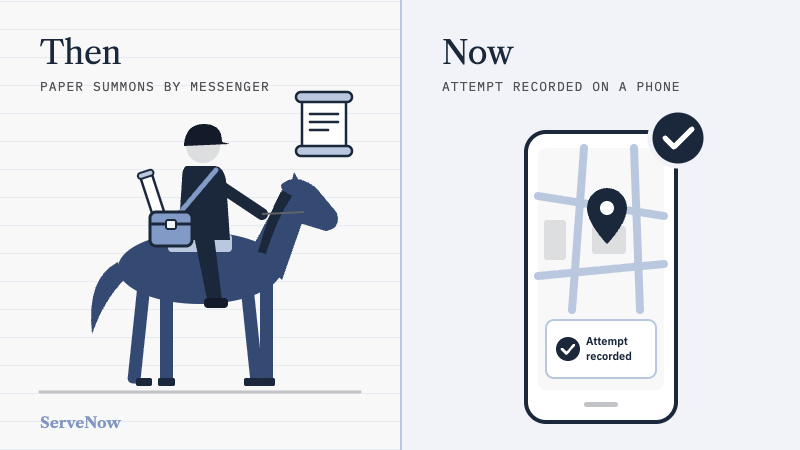
Technology has changed service of process in three main ways: how servers find people, how they record what they did, and how papers can be delivered.
Finding people
Early servers relied on a name, an address and local knowledge. Cars and telephones made it possible to cover more ground and check with neighbors and employers. Databases and online records later made skip tracing much faster. A server can now search public records and other data sources to find a current address. Our guide to skip tracing explains how it works.
Recording what happened
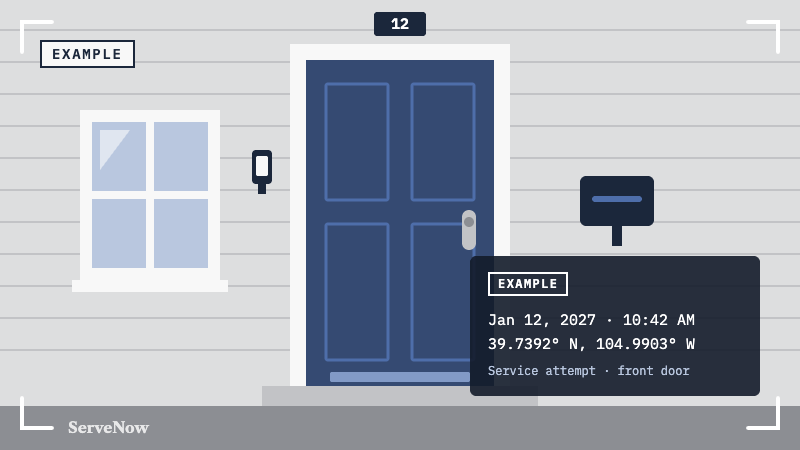
For most of the history of the profession, the proof of service was a signed statement from the server, written after the fact. A defendant who said "I was never served" and a server who said "I served him" produced a contest of memory.
Technology has begun to settle that contest with records made at the moment of service. Two examples:
- New York City. The Department of Consumer and Worker Protection requires process servers to carry and operate an electronic device that records GPS location, time and date while serving process. State law changed in 2022 so that paper logbooks are no longer required when electronic records are kept. See the DCWP's page for the process server industry for the current rules. ServeManager's guide to NYC compliance explains how process serving software records GPS data with each attempt.
- California. The Service of Process Accountability, Reform and Equity Act, known as the SPARE Act or AB 747, takes effect January 1, 2027. It asks servers to attach a photo of each attempt with a date, time and GPS stamp, and to make three attempts at different times before using substituted service or posting in many cases. ServeManager's guide to SPARE Act compliant software walks through each requirement, and our own article explains what the SPARE Act means before you hire a process server.
Body cameras are another tool. Some servers wear them to record an attempt, and our guide explains how to choose a body camera for process servers. Whether a recording is allowed depends on the state's recording laws.
Delivering the papers
For centuries, service meant putting papers in a person's hands, leaving them at a home, or publishing a notice. Electronic communication opened a new path. In 2002, the Ninth Circuit approved service of process by email in a federal case involving an online business that had no reliable street address and did most of its business by email. Since then, courts in some places have allowed email, text message or social media message as alternative service when the usual methods fail. Each court sets its own conditions, and many require the plaintiff to show that normal service was tried and that the electronic method is likely to reach the person. That is the Mullane test applied to new tools. Our guide to alternative service of process covers when courts allow it.
Electronic filing of proof of service has also spread. Servers can often submit proofs to the court electronically, which shortens the time between service and filing.
Ordering service today
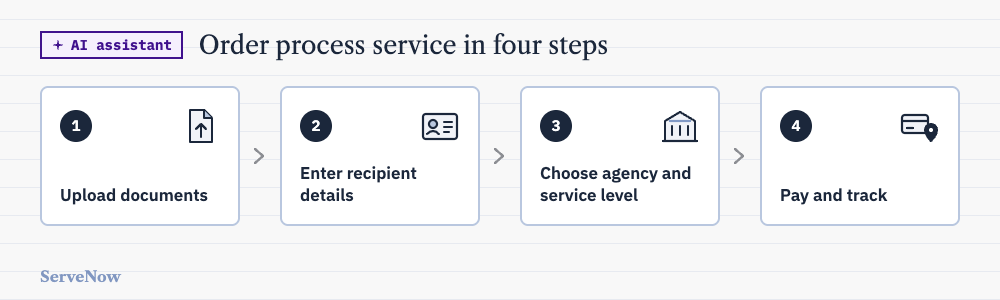
Hiring a server used to mean looking one up in a directory, calling and sending papers by mail or courier. Online ordering has changed that step too.
The ServeNow AI assistant puts ordering in one conversation. You upload your documents, enter the recipient's details, choose a credentialed agency and service level, and pay. After you order, it keeps you updated on the job. Every agency it offers is credentialed, which answers the question courts have asked since the days of the sheriff's summoner: was the person who delivered the papers qualified to do it?
The agencies behind the assistant use process serving software, so the records of each attempt are made as the work happens. That is the same direction the New York and California rules point.
What has not changed
Technology has changed the tools, but the core of the job is the same as it was in the common law courts.
- Notice must be real. The goal is still that the person knows about the case.
- Someone neutral delivers the papers. A party to the case generally cannot serve its own papers. In federal court, only a person who is at least 18 and not a party may serve a summons and complaint.
- There must be a record. The server reports to the court on who was served, when, where and how. That report is now backed by photos and location data in more places.
- Deadlines matter. A case can be dismissed if service is not completed in time. See how long you have to serve papers after filing a lawsuit.
A short timeline
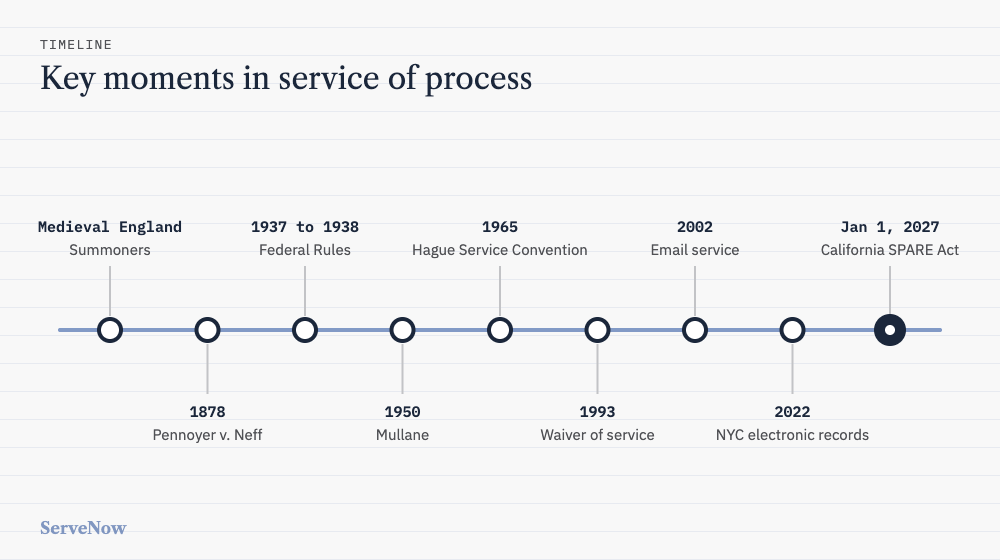
| Period | What changed |
|---|---|
| Medieval England | Sheriff's summoners deliver a summons that orders the defendant to appear on a return day, and the sheriff reports to the court. |
| 1878 | Pennoyer v. Neff ties a state court's power over a person to service within the state or an appearance. |
| 1937 and 1938 | The Federal Rules of Civil Procedure are adopted and take effect, including Rule 4 on service. |
| 1950 | Mullane sets the standard of notice "reasonably calculated, under all the circumstances," to inform parties. |
| 1965 | The Hague Service Convention sets up a system for serving papers across borders. |
| 1993 | Federal Rule 4 adds waiver of service. |
| 2002 | The Ninth Circuit approves service by email in a federal case. |
| 2022 | New York allows electronic records in place of paper logbooks for process servers. NYC still requires GPS records. |
| January 1, 2027 | California's SPARE Act takes effect, with photo, time and GPS records for attempts. |
| Today | Online ordering with an AI assistant, with credentialed agencies and software that records each attempt. |
Related reading
- What is a process server?
- What is an affidavit of service?
- How to hire a process server
- Process server vs. sheriff
Find a process server
Search the ServeNow directory by city or ZIP code, or order service with the AI assistant.
This article is a general overview, not legal advice. Service rules depend on the court, the type of case and your state.
Need papers served?
Chat with our AI to book a process server near the recipient, get a price, or check on an order.